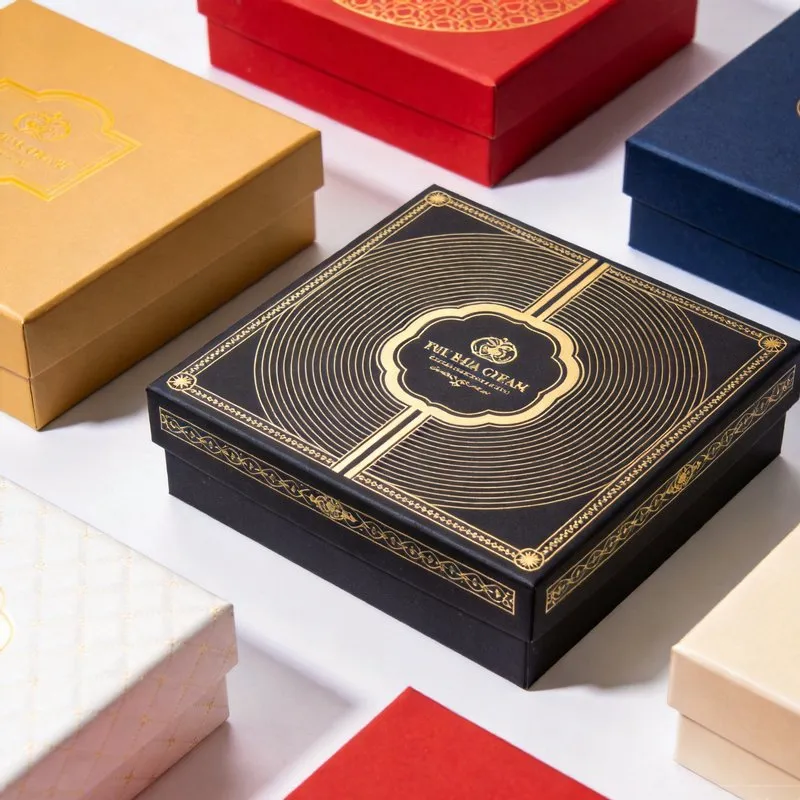
Color Management & PMS Matching: How Bincai Keeps Your Brand Colors Flawless Across 1.7 Million Boxes a Day
For brands selling cosmetics, luxury goods, electronics, and premium food products, color is non-negotiable. That signature Tiffany blue, Hermès orange, or Chanel black-and-white must be identical whether the box was printed today, last month, or next year — and whether you ordered 5,000 or 500,000 units.
At Guangdong Bincai Color Printing, we’ve spent 23 years perfecting the art and science of color management. With 1.7 million boxes produced daily across our 18,000 sqm (10,000+8,000 smart factory) ISO 9001 & FSC certified facility, we maintain color accuracy within ΔE ≤ 2.0 — a tolerance tighter than most global brands require.
Here’s how we do it.
Why Color Consistency Matters in Paper Box Manufacturing
| Industry | Color Criticality | Consequence of Drift |
|---|---|---|
| Cosmetics | Brand logo, lipstick shade boxes | Customer trust erosion, returns |
| Luxury Goods | Heritage colors (Tiffany blue, Cartier red) | Brand dilution, legal issues |
| Electronics | Product photography backgrounds | Unprofessional appearance |
| Food & Beverage | Appetite cues, freshness perception | Reduced shelf appeal |
| Jewelry | Premium feel, gemstone complement | Devalued product perception |
Brand studies show that color increases brand recognition by up to 80%. For packaging manufacturers, this means color management isn’t a nice-to-have — it’s a core competency.
The Bincai Color Management Stack
1. Press-Level Spectrophotometry (Heidelberg Speedmaster XL 105-7+UV)
Our Heidelberg Speedmaster XL 105 7-color + UV coater is equipped with Heidelberg Prinect Inpress Control 3 — an inline spectrophotometer that measures every single sheet as it comes off the press. Unlike offline sampling (where you measure 1 sheet every 500–1000), Inpress Control scans the entire print run in real time.
What this means for your brand:
- Real-time L*a*b* color measurement at 18,000 sheets/hour
- Automatic ink-key adjustment when color drifts beyond ΔE 1.5
- No batch-to-batch variation — every sheet is a “checked sheet”
- PDF report generation for full color traceability
2. Densitometric Control (KBA Rapida 105 4-Color)
Our KBA Rapida 105 4-color offset press uses Techkon SpectroDens handheld spectrophotometers for offline density checks every 500 sheets, supplemented by the press’s integrated ErgoTronic ColorControl system for inline density monitoring.
| Measurement | Instrument | Frequency | Target |
|---|---|---|---|
| Solid ink density | SpectroDens | Every 500 sheets | ±0.05 from target |
| Dot gain (50%) | SpectroDens | Every 1,000 sheets | Within ISO 12647-2 curve |
| Gray balance | Prinect Inpress | Continuous (Heidelberg) | C=M=Y within 2% |
| Spot color ΔE | X-Rite eXact | Every run start + 1,000 sheets | ΔE ≤ 2.0 |
3. ISO 12647-2 Compliant Workflow
Bincai operates under ISO 12647-2:2013 (Process control for offset lithography). This international standard defines:
- Paper type classifications (we run PT1–PT5: gloss coated to uncoated)
- Target CIELAB values for CMYK solids
- TVI (Tone Value Increase) curves
- Gray balance tolerances
Every job at Bincai is profiled against ISO 12647-2 using custom ICC profiles generated with an X-Rite i1iO automated scanning table and i1Profiler software. We maintain separate profiles for:
- Coated paper (FOGRA 51/52)
- Uncoated kraft (custom profile)
- Specialty boards (metallic, black, colored substrates)
- UV-cured inks (FOGRA 53 equivalent)
The 6-Stage Color QC Process at Bincai
Stage 1: Prepress Color Proofing
Before plates are made, every job receives a GMG ColorProof digital proof on the actual production substrate, verified against a FOGRA Media Wedge under D50 (5000K) standardized lighting.
Stage 2: Plate Quality Control
Computer-to-Plate (CTP) output is checked with a Techkon SpectroPlate to ensure dot percentages match the RIP data within 1% across the entire tonal range.
Stage 3: Makeready Color OK Sheet
The press crew pulls an OK sheet, measures it against the GMG proof, and obtains customer sign-off (physical or digital via calibrated photo) before the production run begins.
Stage 4: Inline Continuous Monitoring
Heidelberg Prinect Inpress Control scans every sheet. Any sheet exceeding ΔE 2.0 triggers an automatic ink-key adjustment and a side-mark for manual inspection.
Stage 5: Periodic Offline Verification
Every 1,000 sheets, quality inspectors pull a sample and measure:
- Solid ink density (CMYK + spot colors)
- Dot gain at 25%, 50%, 75%
- Gray balance patch
- Registration marks (±0.05mm tolerance)
Stage 6: Pre-Shipment Color Audit
Before palletizing, random AQL sampling (typically Level II, AQL 1.0) includes color measurement against the OK sheet standard. Any deviation triggers a 100% re-inspection of that production lot.
PMS Spot Color Matching: Beyond CMYK
While CMYK process printing handles most photographic imagery, Pantone Matching System (PMS) spot colors are essential for:
- Corporate logos (Coca-Cola red, Starbucks green)
- Metallic and fluorescent colors
- Brand-specific pastels that CMYK cannot reproduce
- Large solid areas requiring absolute uniformity
Bincai maintains an extensive Pantone Formula Guide library (coated, uncoated, and metallic) and uses X-Rite InkFormulation Software to mix custom spot colors from our in-house ink kitchen. Our ink technicians average 15+ years of experience matching PMS colors by eye and instrument.
| PMS Type | Instruments | Capability |
|---|---|---|
| PMS Solid Coated | X-Rite eXact + Formula Guide | ΔE ≤ 1.5 |
| PMS Solid Uncoated | X-Rite eXact + Formula Guide | ΔE ≤ 2.0 |
| PMS Metallic | X-Rite MA-T12 multi-angle | ΔE ≤ 2.5 |
| PMS Pastels/Neons | Custom ink mixing + eXact | ΔE ≤ 2.0 |
| Brand-specific (non-PMS) | Spectrophotometer profiling | ΔE ≤ 2.0 |
Common Color Challenges & How Bincai Solves Them
| Challenge | Root Cause | Bincai Solution |
|---|---|---|
| Ink dry-back (color shifts after drying) | Ink absorption into substrate | UV curing on Heidelberg 7+1 — instant cure, zero dry-back |
| Metamerism (colors look different under different lighting) | Spectral mismatch | Verify under D50, D65, and A (incandescent) — document spectral reflectance |
| Substrate variation (same PMS on different paper) | Paper brightness/absorbency | Separate ICC profiles per substrate; pre-production substrate batch testing |
| Press-to-press variation (KBA vs Heidelberg) | Different press dot gain characteristics | Calibrated TVI curves per press; shared ICC workflow via Prinect Production Manager |
| Long-run color drift (500K+ boxes) | Ink/water balance fluctuation | Prinect Inpress auto-correction + periodic offline spot checks |
Why Global Brands Trust Bincai for Color-Critical Packaging
- 23 years of paper box manufacturing experience
- 18,000 sqm (10,000+8,000 smart factory) ISO 9001 & FSC certified factory in Shunde, Foshan
- Heidelberg Speedmaster XL 105-7+UV with inline spectrophotometry (continuous sheet-level color control)
- KBA Rapida 105 4-color with densitometric quality control
- Daily output exceeding 1.7 million boxes with consistent color across every unit
- Full ISO 12647-2 compliance with documented, auditable color data
- In-house ink kitchen for same-day PMS spot color mixing
- GMG color proofing on actual production substrates
Ready to Make Your Brand Colors Pop?
Whether you need a single PMS spot color for your logo or full-color packaging with metallic accents, Bincai has the equipment, process, and experience to deliver flawless, repeatable color at any scale — from 1,000 to 1,000,000 boxes.
Contact Bincai to discuss your next color-critical packaging project. Request a free color proof on your actual packaging substrate.
Published by Guangdong Bincai Color Printing Co., Ltd. — Your trusted partner for premium paper box manufacturing since 2003.
Ready to Start Your Packaging Project?
Free consultation · Custom design · Factory-direct pricing
Get a Free QuoteTel: +86-18934352881 | Email: qo82@icloud.com